

Brewing Equipment Manufacturer Reveals Key Design Choices for Craft Quality
2026-10-26
Most brewers don’t fail because of bad recipes. They fail because their equipment quietly works against them. That’s a hard truth DYE—a brewing equipment manufacturer—has learned from years of designing systems for craft breweries. In a recent deep dive, the company revealed which design choices actually move the needle for quality, and which so-called upgrades are just marketing noise. From false bottom geometry to heat distribution, the difference between average and exceptional often hides in the details nobody thinks to ask about.
Stainless vs Copper Surfaces and Their Real Effect on Flavor
Most home cooks assume copper automatically makes food taste brighter. The reality is less about the metal itself and more about how it transfers heat. Copper responds quickly to flame changes, so reductions and sugar work can be stopped before they drift into bitterness. Stainless steel, especially tri-ply, distributes heat more evenly than cheap aluminum but still reacts slower than copper. That delay can change how volatile aromatics survive in a dish, giving the impression of a duller finish even when the ingredients are identical.
There is also a chemical angle that gets exaggerated. Copper ions can leach in trace amounts when cooking acidic ingredients for long periods, which occasionally adds a faint metallic edge or can stabilize egg foams. Stainless steel remains essentially inert with wine, citrus, and tomatoes, so it preserves the intended acid balance. For most everyday recipes, the flavor difference people notice has less to do with the surface material and more to do with whether the pan allowed them to hit the right temperature at the right time.
If you are comparing pans side by side, try the same lemon-butter sauce. In copper, the butter browns faster and you get nutty notes before the lemon turns harsh. In stainless, you may need to work a little harder to avoid scorching the milk solids because the heat recovery is slower. Neither metal is objectively better; they simply reward different habits.
Why Oversized Cooling Jackets Prevent Off-Flavors in Fermentation
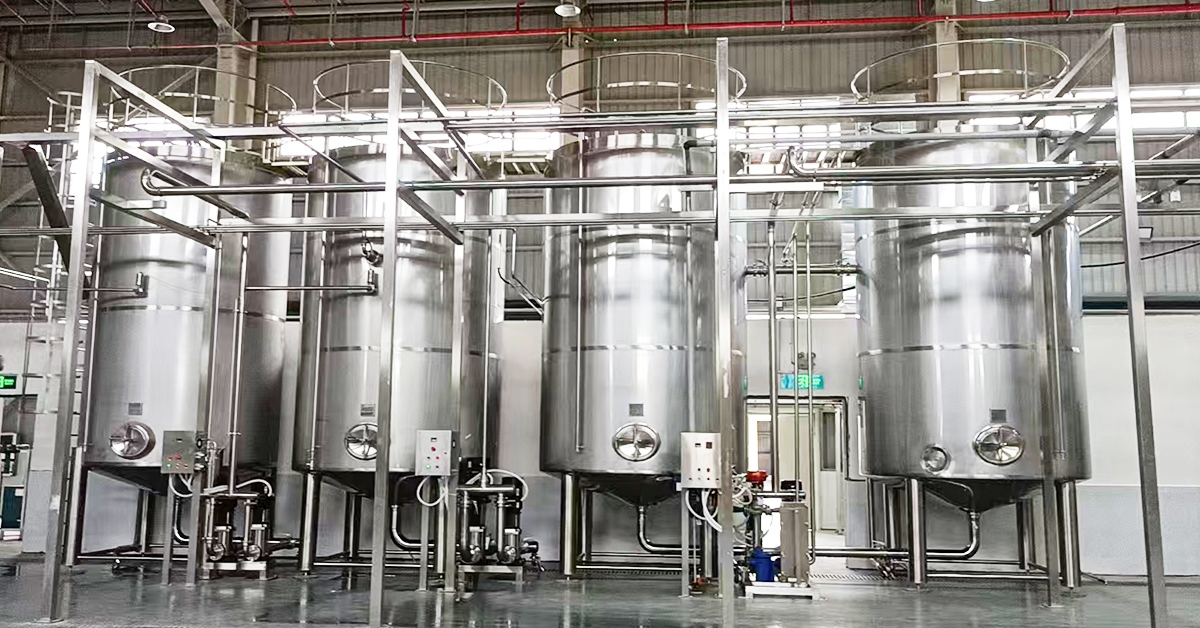
Fermentation is exothermic, and without rapid heat removal, yeast activity can push the wort or must well beyond the ideal temperature range. Stressed yeast then produces higher alcohols, acetaldehyde, and sulfur compounds that linger as harsh, solvent-like, or vegetal notes in the finished product. A cooling jacket that is larger than the bare minimum needed for steady-state cooling gives the fermenter extra thermal buffering, so even aggressive fermentations won't spike into the danger zone as easily.
The oversized surface area also allows the coolant to run at a more moderate temperature while still pulling heat away efficiently. Instead of blasting near-freezing glycol through a small jacket—which can create steep temperature gradients and shock the yeast near the vessel walls—a larger jacket spreads the same heat transfer across more metal. This reduces localized cold spots and prevents the yeast from flocculating early or going dormant, both of which can lead to incomplete attenuation and off-flavor precursors left behind.
Finally, consistent jacket coverage down the sidewall and across the cone helps maintain a uniform thermal profile from top to bottom. Convection currents inside the fermenter stay more balanced, so yeast remains in suspension and finishes cleaning up diacetyl and acetaldehyde. By avoiding both hot spots and cold shocks, an oversized cooling jacket keeps fermentation clean and steady, which is the most direct way to suppress the off-flavors that arise from temperature stress.
Fewer Welds, Cleaner Beers The Case for Smooth Vessel Interiors
Every welded seam in a fermentation vessel is a potential hiding spot for bacteria, wild yeast, and beer stone. Even with careful grinding and passivation, the microstructure around a weld can remain slightly rougher than the surrounding steel. That roughness gives unwanted microbes a foothold that is difficult to reach during routine cleaning cycles. By reducing the number of welds, brewers eliminate these micro-crevices almost entirely, leaving behind a surface that stays cleaner with far less effort.
Smooth interiors also simplify clean-in-place operations. Spray balls and chemical solutions can reach every square centimeter without the shadow zones or pooling that often occur near weld undercuts or heat-affected areas. The result is a more predictable sanitation process, shorter rinse times, and lower chemical usage. Over the life of a tank, those savings add up in both time and water, without compromising the integrity of the vessel.
From a brewer's perspective, the payoff shows up in the glass. Fewer stubborn deposits mean fewer off-flavors from autolyzed yeast or bacterial byproducts. A cleaner vessel interior doesn't just make maintenance easier; it protects the delicate aromatics and flavors that define a well-made beer. In the end, the case for smooth interiors is simple: less metalwork, less risk, and a noticeably cleaner final product.
Pump Placement and Aeration Mistakes That Quietly Ruin Batches
Most brewers focus on sanitation and temperature, but pump placement quietly decides whether a batch picks up unwanted oxygen. If the pump sits above the liquid level or has a restrictive inlet line, it will cavitate. Those tiny collapsing bubbles don't just make noise; they inject air into wort or beer, and on the hot side that oxygen can dull malt freshness and accelerate staling flavors down the road.
A pump should be mounted below the vessel outlet so the inlet stays flooded. Even a small air pocket on the suction side turns a smooth transfer into a surging, splashing mess. Keep the inlet hose short, straight, and at least as large as the pump inlet—many homebrew pumps are meant to be gravity-fed, not to pull liquid uphill. Also check fittings and hose clamps: a loose connection on the suction side can pull in air without leaking a drop, so the problem stays invisible until the beer tastes tired.
On the return side, avoid letting wort or beer stream down through open air. A hose that discharges above the liquid surface creates constant splashing and aeration at exactly the wrong time. Submerge the return hose or point it against the vessel wall so liquid enters gently. If you recirculate during mashing or whirlpooling, watch for a vortex forming at the inlet—that funnel of air gets sucked straight into the pump and then into the batch.
Quick-Clamp Fittings That Cut Cleaning Time Without Sacrificing Sanitation
Quick-clamp fittings have changed the way food and beverage plants approach sanitation. Instead of wrestling with threaded connections that trap residue in hard-to-reach grooves, maintenance teams can now break down a line in seconds, wipe the exposed surfaces, and put everything back together without a single tool. The real advantage shows up during shift changes, when every minute of downtime counts. By swapping out conventional joints for these smooth-bore, gasket-sealed clamps, you eliminate the tiny crevices where bacteria like to hide, and you give your crew a faster path to a verified clean.
What makes these fittings stand out is that speed never comes at the cost of hygiene. Each connection uses a high-purity gasket seated in a recessed groove, so there is no exposed thread or dead leg for product to collect in. The clamp itself applies even pressure around the entire circumference, keeping the seal tight without over-compressing the gasket. In practice, that means fewer re-torques, less chance of a leak that goes unnoticed, and a much simpler swab test at the end of the sanitation cycle. Plants that have made the switch often report reducing their clean-in-place cycle times by a noticeable margin, while their micro results stay just as consistent as before.
If you are looking at a retrofit, the transition is usually straightforward. Most quick-clamp components are designed to match existing tube diameters and wall thicknesses, so you do not need to rebuild an entire process line. Start with the highest-risk points: transfer panels, fillers, and any spot where a threaded joint gets opened more than once a day. Once your operators feel how much less time they spend on teardown and reassembly, the case for expanding the system makes itself. The result is a cleaner line, a shorter sanitation window, and a crew that spends more time running product instead of chasing threads.
Programmable Mash Steps That Recreate a Seasoned Brewer's Instincts
A fixed single-infusion mash treats every grain bill as if it were identical. Programmable mash steps break that assumption by letting you set precise temperature rests, ramp rates, and hold times that mirror what a seasoned brewer would do manually. For example, a protein rest at 52°C can rescue head retention in undermodified malt, while a slow climb to 63°C gives beta-amylase more time to produce fermentable sugars. Instead of watching a clock and guessing, the controller follows a path that would otherwise live only in the brewer's head.
Real instinct isn't just hitting numbers — it's knowing when to bend the schedule. A brewer might extend a beta-glucan rest because the mash looks gummy, or skip a decoction when the iodine test clears early. Programmable profiles capture that flexibility by storing not just temperatures but ramp slopes, pause conditions, and heat-on/heat-off thresholds. The result reads less like a rigid recipe and more like field notes: a 10-minute acid rest at 35°C for a pilsner, a step mash tuned for a high-adjunct lager, a ferulic acid rest saved for a clove-forward hefeweizen.
Over time, these stored programs become your own library of brewing instincts. You can reuse a mash schedule that worked well for a dry stout, then adjust the saccharification rest upward by a degree for a sweeter porter without starting from scratch. The machine doesn't think for you — it just remembers the small, hard-won adjustments that usually stay in a brewer's notebook.
FAQ
We switched to a higher nickel alloy because standard 304 steel was showing micro-pitting after repeated exposure to acidic wort. The new alloy doesn't just resist corrosion; it also eliminates metallic off-flavors that brewers often can't pinpoint.
Boil dynamics change with geometry. A wider surface area gives a more even evaporation rate and reduces scorching at the edges, which lets us use a gentler heat source without sacrificing hop utilization.
The slots are laser-cut with a tapered undercut rather than stamped, so husk particles wedge less often. That means even a 30% rice or corn mash runs off without constant raking, which is usually where small breweries lose hours.
Tri-clamps are great for flexibility, but every gasket is a place for biofilm to hide. We hard-pipe the cold-side connections and weld the few remaining joints. It costs more upfront, but the payoff is in reduced infection risk and less tear-down time for cleaning.
Instead of one continuous jacket, we split the cone and body into separate zones with independent temperature probes. That lets brewers crash the cone for yeast harvesting while keeping the bulk beer a few degrees warmer, which avoids thermal shock and preserves ester profile.
The tilt lets air escape naturally during the first seconds of knockout. If the exchanger is perfectly horizontal, an air pocket can form at the top of the plates and cause a temperature spike that denatures proteins before the wort even reaches the fermenter.
Mechanical polishing leaves microscopic grooves where soils can anchor. Electropolishing smooths the surface at a micron level, which not only makes cleaning cycles faster but also reduces the total volume of water and chemicals a brewery uses over a year. It's a sustainability win disguised as a quality upgrade.
Honestly, the oversized manway on the fermenter. It sounds trivial, but if your brewer can actually see and reach every inch of the interior during a visual inspection, dry-hop additions and dry-hop residue removal stop being guesswork. It increases batch consistency more than any single piece of automation.
Conclusion
A brewing equipment manufacturer's latest deep dive into craft quality starts with the surfaces beer actually touches. Stainless steel and copper each bring something different to the kettle—copper can lend a subtle character but demands relentless upkeep, while stainless offers neutrality and easier cleaning—yet the real lesson is less about romantic metals and more about what lingers after the boil. Oversized cooling jackets, for instance, do more than drop temperature fast; they prevent the slow, uneven cooling that lets unwanted compounds creep into fermentation. The same logic applies to vessel interiors: every weld is a hiding place for residue, so smooth, continuous walls with minimal seams become a quiet defense against off-flavors that no amount of scrubbing can fully undo.
Beyond the tank itself, small layout decisions matter more than most brewers expect. A poorly placed pump or an air intake left in the wrong spot can oxidize a batch before anyone notices, and these aren't flashy features—they're the kind of engineering choices that separate consistent craft beer from occasional accidents. Quick-clamp fittings, on the other hand, strip away the time and frustration of tearing down threaded connections, keeping sanitation practical rather than theoretical. And for those who want repeatability without losing the human touch, programmable mash steps let a system mimic the intuition of a seasoned brewer—holding, ramping, and resting at exactly the moments that turn good wort into great beer.
Contact Us
Contact Person: Ada Xu
Email: [email protected]
Tel/WhatsApp: 0577-86806088
Website: https://www.dayuwz.com/