

China Calcium Chloride 77% Prills – Essential Guide to Properties and Uses
2026-11-16
When it comes to industrial drying, dust control, or de-icing, few chemicals work as quietly and effectively as calcium chloride 77% prills. But not all sources are equal—quality, purity, and reliability vary widely. In this guide, we’ll break down the key properties and practical uses of this versatile material, drawing on insights from Shouguang Golden Chemical, a supplier known for consistent performance. Whether you’re managing a large-scale operation or simply curious about how these small white beads solve big problems, you’ll find clear answers here.
What Sets 77% Prills Apart from Lower-Concentration Calcium Chloride
Most calcium chloride products sit around 74% concentration, but 77% prills deliver a sharper edge where it matters. That extra three percent isn't just a numerical bump—it reduces the amount of product you need per application, cuts down on handling and storage volume, and gives faster melting response on ice or faster moisture absorption in dust control. In practice, crews notice the difference when a single pass does what used to take two.
Lower-concentration flakes or pellets often carry more water weight, which means you're paying to transport and spread inert material. 77% prills, by contrast, are dense and uniform, so they meter more consistently through spreaders and resist caking in humid conditions. The higher purity also leaves less residue behind, a detail that matters on concrete, vegetation, and equipment longevity.
Field feedback tends to highlight one thing: reliability at lower temperatures. While 74% material can stall out in bitter cold, 77% prills keep working because the active ingredient is more concentrated and the exothermic reaction kicks in faster. For anyone who has fought ice at -10°F or struggled with dusty gravel roads in summer, that edge translates directly into fewer callbacks and better road conditions.
Physical Traits That Influence Handling, Caking, and Storage Life
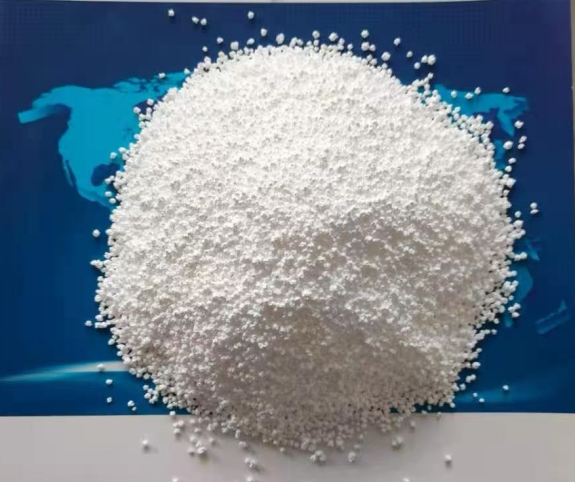
Particle size and shape dictate how freely a powder moves through hoppers, chutes, and packaging lines, with fine or irregular particles often creating more interlocking and higher internal friction. Smaller fractions also pack tighter under their own weight, which reduces air pockets and leaves less room for moisture to escape. Once humidity finds its way into these dense beds, capillary bridges form between adjacent grains, and that is when noticeable clumping starts to appear.
Surface moisture, even in amounts well below visible wetness, acts like a slow-setting glue across particle contacts, gradually turning loose material into solid lumps. Hygroscopic ingredients pull water from the surrounding air during storage, so their caking tendency rises sharply in humid environments unless barrier packaging or desiccants are used. Meanwhile, storage time itself compacts the bulk via vibration or static load, which increases bulk density and makes the powder more resistant to flow when it is finally discharged.
Flowability indicators such as angle of repose and compressibility give a practical read on how the material will behave downstream, though these values shift with temperature cycles and prolonged resting. A high angle of repose usually signals cohesive, sticky behavior that will demand more aggressive bin design or flow aids. Monitoring these physical traits before and after storage helps predict whether the product will pour easily or arrive at the customer as a solid block.
Why Road Crews and Site Managers Choose Prills for De-icing and Dust Control
Prills beat flake and granular alternatives on the loading dock before a single bag is opened. Their uniform spherical shape prevents the clumping and bridging that plague irregular materials, so hoppers empty cleanly and spreader calibrations stay consistent from the first pass to the last. For road crews working against an approaching cold front, that reliability means less downtime clearing jammed augers and more trucks rolling through the gate with exactly the right amount of product on board.
The same physical characteristics translate directly to field performance. When prills hit a frozen surface, their round profile reduces bounce and roll-off, keeping more material in the wheel tracks where it actually works. In dust control applications, the consistent size distribution allows for predictable coverage rates and slower dissolution, which stretches a single application across a longer shift. Site managers appreciate that they aren't chasing wind-blown fines or dealing with uneven melting patterns that leave slick spots behind.
Storage and handling also tilt the decision. Prills resist moisture absorption better than crushed rock or flake products, so stockpiles stay loose through freeze-thaw cycles and spring rain. That lowers waste from hardened piles and makes inventory counts simpler—a practical advantage when budgets are tight and every ton has to justify its place on the yard.
Overlooked Industrial Uses from Food Processing to Oilfield Brines
Salt rarely gets credit for the behind-the-scenes roles it plays long before food reaches a plate. In meat processing, a carefully controlled brine isn't just for flavor—it alters protein structure so that sausages and hams bind properly, hold moisture, and resist spoilage without relying solely on refrigeration. The same principle shows up in cheese making, where salt pulls whey from curd, slows unwanted bacterial growth, and creates the rind environment that allows beneficial molds to take hold. Vegetable fermentations from sauerkraut to kimchi depend on salt concentrations precise enough to favor lactic acid bacteria while suppressing pathogens—a balancing act that industrial producers monitor far more closely than home recipes suggest.
Away from food plants, oilfield brines represent another quiet workhorse. The high-density salt solutions used during well completion and workover operations prevent blowouts by balancing formation pressure, and they don't damage reservoir clays the way freshwater can. Produced water—the brine that comes up with oil and gas—is increasingly treated not just for disposal but as a source of lithium, bromine, and even magnesium, turning a waste stream into a mineral feedstock. These applications rarely make headlines, but they keep both food production and energy extraction running in ways that standard supply-chain conversations overlook.
How Moisture Attraction Works and What It Means for Packaging Choices
Moisture attraction, at its core, is a tug-of-war between a material's surface and the water molecules floating around it. Some surfaces, like those with plenty of polar groups, practically reach out and grab water from the air, pulling it into the material's structure. Others stay aloof, repelling moisture through nonpolar chemistries or tight crystalline packing. The rate and strength of this pull depend on relative humidity, temperature, and the material's own porosity—microscopic nooks can trap water droplets even when the bulk surface seems hydrophobic. Understanding this isn't just lab trivia; it dictates whether a package keeps crackers crisp or lets them go soggy in a humid pantry.
For packaging engineers, the real question is how to match the barrier to the product's sensitivity. A hygroscopic material like nylon will absorb moisture and swell, altering its barrier properties and sometimes warping the film. Meanwhile, materials like polyethylene or PVDC create a dense, nonpolar shield that slows water vapor transmission dramatically. But no single material wins for every scenario: a breathable produce bag wants moderate moisture exchange to prevent condensation, while a desiccant pouch demands near-zero permeability. The art lies in layering—combining a moisture-attracting inner layer with a moisture-blocking outer layer, or adding desiccant inserts to actively scavenge water before it reaches the product.
That tug-of-war also affects shelf life and structural integrity. Packaging that absorbs moisture can lose stiffness, peel at seals, or become a breeding ground for mold. Conversely, an overly impermeable package for a product that gives off moisture—like fresh bread—will trap humidity inside, creating a wet, sticky mess. Smart choices come from testing water vapor transmission rates under real-world conditions, not just ideal lab specs. Blister packs for pharmaceuticals, for example, often use a cold-form foil base to block moisture completely, because even a slight humidity spike can degrade active ingredients. In the end, moisture attraction isn't a villain—it's a force to be measured, balanced, and sometimes harnessed for the job at hand.
Points to Check When Comparing Chinese Suppliers of 77% Calcium Chloride Prills
Assessing a Chinese supplier goes well beyond the price per ton. Start by requesting a certificate of analysis from a recent production batch, then cross-check the stated purity against independent lab results if possible. Pay close attention to impurities like magnesium, sodium chloride, and insoluble matter—these affect how cleanly the prills dissolve and whether they will clog spray nozzles or leave residue in brine systems.
Logistics reveal a supplier's real capabilities. Ask about moisture-proof packaging, typical loading times at their nearest port, and how they handle winter shipping when calcium chloride tends to absorb moisture and clump. The best suppliers proactively switch to vacuum-sealed bags or add desiccant layers during humid months, while less experienced ones will promise fast delivery but ship product that arrives with hard lumps and reduced free-flowing content.
Finally, verify their consistency over time. Request records from three or four previous export shipments—not just samples—and note whether the prill size distribution stays within the promised range. A supplier who can show stable particle size, low dust percentage, and on-time documentation for multiple quarters is far more reliable than one offering a spot discount on a single container.
FAQ
They are small, spherical granules with roughly 77% calcium chloride content by weight. The prilling process gives them a uniform size, low dust, and slower dissolution compared to flakes or powder, which makes them easier to handle in deicing spreaders and industrial dosing systems.
It balances purity and practicality. Higher grades cost more and may absorb moisture too aggressively, while lower grades leave more residue. At 77%, you get strong ice-melting and moisture-absorbing performance without excessive caking if stored properly.
They are widely used for dust control on roads and construction sites, accelerating concrete set time in cold weather, oilfield drilling fluids, tire weighting, and wastewater treatment to remove impurities. Their spherical shape also suits brine production.
The round, compact shape allows even spreading with minimal bridging in hoppers. Prills penetrate ice gradually, generating heat as they dissolve, and their slower release can provide longer-lasting melting action than fine powders.
Yes. They are hygroscopic, so keep them in sealed bags away from humidity. Use gloves and eye protection because dust or contact can irritate skin and metal surfaces. Ensure storage area has good drainage, because spilled prills will attract moisture and leave a slippery brine.
Calcium chloride works at lower temperatures (effective below -20°F/-29°C), acts faster, and releases more heat when dissolving. It is less corrosive to concrete than some chloride salts but still requires care around metals. It tends to cost more per ton than rock salt but less is needed per area.
No. The 77% technical grade is typically not food or pharmaceutical grade. Those applications require higher purity, stricter heavy metal limits, and separate certifications. The prills covered here are for industrial, deicing, construction, and agricultural uses.
Confirm actual CaCl2 content (often 74-77% on anhydrous basis), moisture, magnesium and alkali metal chlorides, sulfate, water-insoluble matter, pH, and particle size distribution. Ask for a recent third-party certificate of analysis and packaging details to prevent moisture damage.
Conclusion
The 77% prill grade occupies a practical middle ground among calcium chloride products, delivering more active de-icing and dust-suppressing power per kilogram than lower-concentration flakes or liquids while avoiding the handling penalties of anhydrous material. Its spherical form resists bridging and compacts less than irregular flake, so silos and hoppers feed more consistently, and the prills remain free-flowing longer when stored under reasonable conditions. The exothermic reaction with moisture makes the product valuable for winter road crews and site managers: it melts ice at temperatures where rock salt loses effectiveness, and on unpaved surfaces it pulls enough atmospheric water to keep fines from becoming airborne. Less obvious uses include adjusting brine density in oilfield operations and controlling texture or mineral balance in certain food-processing steps, where the purity and consistent granule size simplify metering.
Because 77% prills are aggressively hygroscopic, packaging choices matter more than many buyers assume. Exposure to humid air quickly forms a surface film that can trigger caking, so resealed bags, sealed liners, or supersacks with moisture barriers perform noticeably better than simple woven sacks. When comparing Chinese suppliers, it pays to look beyond quoted price: request particle-size distribution, calcium chloride assay, and trace impurity data for magnesium, alkali metals, and iron. Also check whether the supplier uses a consistent prilling process or blends different batches, since uneven granules can undermine the storage and handling advantages described above. A supplier that can provide stable packaging, transparent specs, and steady logistics will usually save more downstream than one offering a slightly lower per-ton rate.
Contact Us
Contact Person: Tom Cui
Email: [email protected]
Tel/WhatsApp: +8618663670626
Website: https://www.jinjigoldenchem.com