

Investment Casting Manufacturer Explains How Precision Metal Components Are Made
2026-11-19
Most precision metal parts don't start with metal at all—they start as wax patterns, ceramic shells, and a single high-stakes pour. At Supreme Machinery, that sequence is handled as a controlled craft instead of a black-box process, which is why the resulting components hold tolerances other methods struggle to match. This walkthrough breaks down exactly how those complex shapes emerge, from first pattern to finished casting.
The Wax Pattern Is the First Sacrifice
In lost-wax casting, the wax pattern is the first thing to disappear. It is carved or shaped to hold every intended line, ridge, and hollow, yet none of that detail is allowed to remain. The model exists to create a vacancy, not to survive the process.
Once the mold is built around it, heat is introduced and the wax runs out, leaving a negative space that will later receive the molten metal. That loss is not accidental. The pattern gives up its own form so the metal can take the same shape with greater permanence.
In this sense, the wax is not merely removed; it is sacrificed. What remains in the finished piece is a kind of memory of the original model, carried forward through absence and replacement.
Ceramic Slurry Turns a Soft Pattern Into a Hard Mold
A soft polyurethane pattern is dipped or brushed with a ceramic slurry, often in several thin layers, until the coating builds up enough body to stand on its own. The slurry fills every surface irregularity and then hardens by drying or chemical set, locking the original soft shape into a rigid ceramic skin.
After the shell firms up, heat removes the pattern inside. The soft material burns away cleanly or melts out through an opening, leaving a cavity that mirrors the original texture without parting lines or draft concerns. That cavity is then ready for molten metal or another castable material.
This approach works especially well when a pattern is too fragile or too detailed for a conventional split mold. Instead of forcing the pattern to release from a tool, the tool is built around it and the pattern is sacrificed, so the hard mold emerges with the exact same geometry.
The Wax Leaves Before the Metal Shows Up
Lost-wax casting has a quiet choreography all its own. The wax model is never meant to last; it is a placeholder, a ghost of the final form. Before any bronze or silver can take shape, that original sculpture is melted away, leaving behind a hollow void in the ceramic shell. What remains is not just empty space but a precise absence, a negative that remembers every curve and ridge the wax once held.
This disappearance feels less like destruction and more like a handoff. The wax yields its shape to the mold, then slips out through the sprue, unseen and uncelebrated. Only after that exit does the metal arrive, filling the very cavities the wax defined. The transition is almost poetic: something soft and temporary makes way for something hard and enduring, yet the fingerprint of the wax stays locked in the metal's surface.
Foundry workers often say you cannot rush this step. If any wax lingers, the pour will sputter and spit, ruining hours of careful work. So the burn-out is patient, gradual, complete. The wax leaves before the metal shows up, and in that deliberate sequence, the artwork finds its permanent skin.
Pouring Precision Into a Hollow Ceramic Shell
The hollow ceramic shell does not forgive hesitation. Metal arrives at the sprue at a controlled temperature, and the shell, preheated to a narrow band, pulls the liquid forward through thin-walled cavities that would collapse under careless heat. Pouring here is less about volume and more about steering: a slight tilt, a restrained stream, the angle of the crucible adjusted so the alloy enters without folding air into itself or washing loose a fragile edge.
Inside the shell, the pour becomes a negotiation between fluidity and restraint. A fast pour risks turbulence, erosion of the inner face, or trapped oxides; a slow pour lets the leading edge freeze before the farthest detail fills. Foundry workers read the pool brightness and the curl of vapor from the shell's mouth, adjusting pace to the alloy's own behavior rather than a fixed recipe.
That control carries through the moment the metal stops moving. The hollow shell, now dense with heat, sets the cooling gradient from the outside inward, so the last metal to enter can still feed the first sections to solidify. It is not the shell's shape alone that matters, but how steadily the pour gave it a full, quiet fill.
Breaking the Shell Without Breaking the Casting
The phrase gets tossed around in metalworking circles like a half-remembered rule: you can crack the mold, but only if the shape inside stays true. In practice, that line gets blurry. The shell is the disposable ceramic or sand skin built up around a wax or foam pattern, and the casting is the metal that fills the void after the shell is burned out and broken away. One of the quiet mistakes is treating the shell as an enemy to be smashed rather than a boundary to be released. When the shell is too thick, the metal cools unevenly and the surface picks up a grainy texture. Too thin, and the pour can blow through it before the metal even settles. There is a rhythm to breaking it: not a single violent strike, but a series of small fractures that follow the parting lines and the natural weak points, like peeling bark off a living branch.
What gets overlooked is how much of the final part's character comes from that violent moment of separation. A well-made shell will leave a fine, almost papery residue on the casting that brushes off with a wire wheel, while a poorly bonded one leaves chunks of ceramic embedded in the metal or tears at the details. The skill is in reading the shell before you touch it: the color after firing, the sound it makes when tapped, the way it resists a light squeeze. Some foundry workers will tell you they can feel the difference in their wrists, the way a good shell gives way in predictable slices instead of shattering into dust and shrapnel. That sensitivity doesn't come from a manual. It comes from breaking a hundred shells and noticing which ones surrendered cleanly and which ones fought back and left scars on the work.
There is also a philosophical weight to the phrase, because the shell is often a stand-in for protection that has outlived its purpose. In casting, the shell is necessary right up until the instant it is not, and then it is only useful as waste. The transition is abrupt, and learning to judge that exact moment separates someone who pours metal from someone who understands the threshold between support and constraint. You don't break the shell to prove strength; you break it because the casting has already formed its own integrity underneath. The best break isn't the loudest one. It's the one that leaves the casting standing on its own, surrounded by a quiet pile of shell fragments that did their job and then stepped aside.
The Final Grind and Inspection Set the Tolerance
A turned part that measures perfectly in the chuck can still drift once it hits the grinding room. The final grind is where the real tolerance band gets decided, because it removes the last few microns that machining left behind while the inspection setup watches every pass. Temperature, wheel wear, and coolant flow all nudge the size around, so the operator has to measure between cuts rather than trust the dial alone.
Inspection at this stage is not a formality. A bore gauge or a set of micrometers placed on a freshly ground surface tells you whether the tolerance is actually holding or just looking good on paper. If the finish is too coarse, the high spots collapse later and the effective size changes. That is why the tolerance is considered set only after the surface finish and the dimensional check agree.
Once the final grind and inspection agree, the part leaves with a boundary that no downstream step should disturb. A burr left on an edge or a careless handling mark can push a feature outside the allowed range without changing the machined number. The tolerance, in practice, is the size you can verify on the finished surface, not the value that existed earlier in the process.
FAQ
Each part starts as an injected wax replica, usually made in a metal die. The wax is cooled, inspected, and often assembled onto a central wax sprue with other patterns. That cluster becomes the flow path for all the metal that will later enter the mold.
The ceramic shell builds up in fine layers around the wax, so it picks up much sharper detail than sand. Once fired, the shell is strong enough to hold molten metal and smooth enough to leave a clean surface, which cuts down on secondary finishing.
Most castable alloys work, but the common ones include stainless steels, carbon steels, aluminum, cobalt alloys, and nickel-based superalloys. It really shines with alloys that are difficult to machine because you can form the shape before you ever touch a cutting tool.
It depends on part size and geometry, but a typical range is around plus or minus 0.005 inch per inch, with tighter work possible on smaller features. We usually recommend leaving a little stock on critical surfaces if they need to be honed or ground afterwards.
Machining removes material from a block, which wastes metal and takes time on complex shapes. Investment casting forms the near-net shape in one shot, including internal cavities and awkward curves, so you only do light machining where fits and finishes demand it.
Yes. The process handles very small parts weighing a few grams up to roughly 100 pounds or so, depending on the foundry. Beyond that, handling the shell and controlling solidification becomes harder, so other casting methods may make more sense.
Thin walls are controlled by preheating the shell and using alloy-specific pouring temperatures. Internal passages are formed by ceramic cores that stay in place during casting and are later removed. The key is designing the core so it can be leached out without damaging the part.
A typical investment cast surface falls around 125 microinches RMS, often better on small features. That is usually smooth enough for many non-sealing surfaces, but sealing faces and bearing bores may still need a light machine pass.
Conclusion
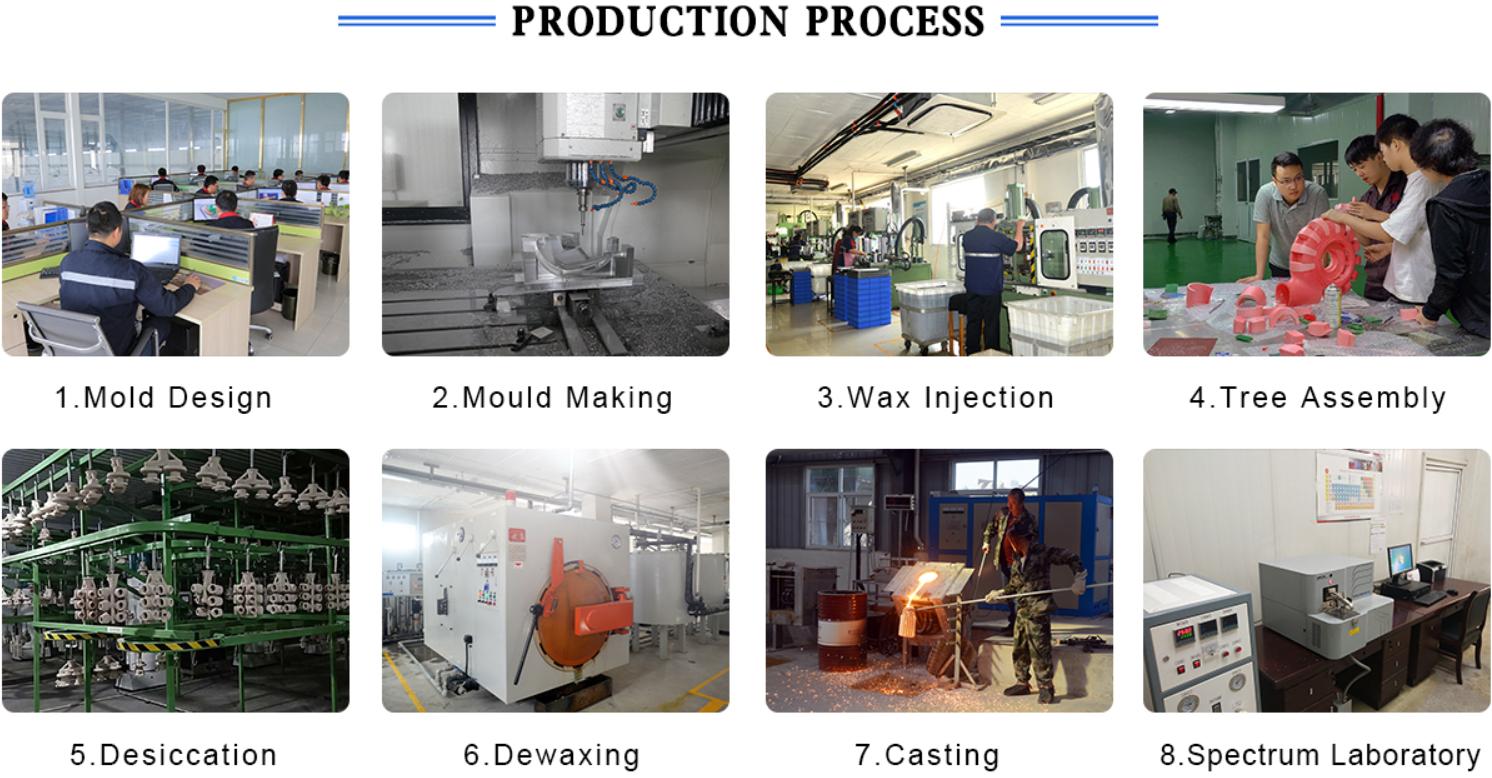
Precision metal components begin with a wax pattern that is never meant to survive. Tooling injects heated wax into a die to capture the part's exact geometry, and multiple patterns are often attached to a central sprue to form a tree. This assembly is then dipped repeatedly into a fine ceramic slurry and coated with refractory sand, layer by layer, until the soft wax carries a rigid ceramic shell. Once the shell is thick enough, heat or steam melts the wax out, leaving a clean hollow cavity that mirrors every contour the finished metal part will need. That disappearing act is why the process is often called lost-wax casting.
Molten metal is then poured into the preheated ceramic shell, with temperature and pour speed controlled to fill thin walls and detailed features without turbulence or premature solidification. After cooling, the shell is cracked away through vibration or light blasting, exposing the cast tree without damaging the components inside. Individual parts are cut from the sprue, and the remaining gate stubs are ground flush. Final inspection brings everything into tolerance: dimensional checks, surface finish verification, and sometimes radiographic or dye-penetrant testing confirm that the component matches the original design before it leaves the foundry.
Contact Us
Contact Person: Paul
Email: [email protected]
Tel/WhatsApp: 8615067447509
Website: https://www.spironcasting.com