

Known Food Extruder Types and Their Best Uses in Modern Food Processing
2026-11-24
Few pieces of equipment shape modern food production as quietly as the extruder. From puffed snacks and breakfast cereals to pet treats and texturized proteins, the right machine can turn a simple recipe into a signature product. Yet choosing among the many known food extruder types is where most processors lose time and money. At MINGDE, we see the same question again and again: which extruder actually fits your line, your budget, and your end product? This guide cuts through the noise. We’ll break down the main extruder types, what each one does best, and how a smarter match can raise output without forcing you into a one-size-fits-all machine.
Single-Screw Lines That Still Keep Simple Doughs Moving
Plenty of bakeries have moved on to more complex mixing and extruding setups, but single-screw lines still earn their floor space when the job is straightforward dough transport. The screw turns at a steady rate, nudging the mass toward a cutting or forming station without beating air into it or overheating the gluten structure. For short doughs, cracker bases, and certain breadstick mixes, that gentle, continuous push is often exactly what the process needs.
The appeal is mostly operational. There is one screw to pull, one barrel to clean, and a short list of wear points to inspect between runs. A shift operator can learn the line’s rhythm quickly, and changeover rarely spirals into a long shutdown. When output targets are modest and the recipe does not change ten times a day, the simplicity of a single-screw line keeps the line moving instead of the maintenance crew chasing it.
It is not the right tool for every dough, and nobody pretends it is. Layered fills, sharp inclusions, or widely varying moisture levels can still push a plant toward twin-screw alternatives. But for a simple dough that just needs to keep flowing predictably, the single-screw approach remains hard to fault. Many lines from the 1990s are still running because they do one thing without unnecessary drama.
Twin-Screw Extruders for Sticky, Chunky, or High-Protein Blends
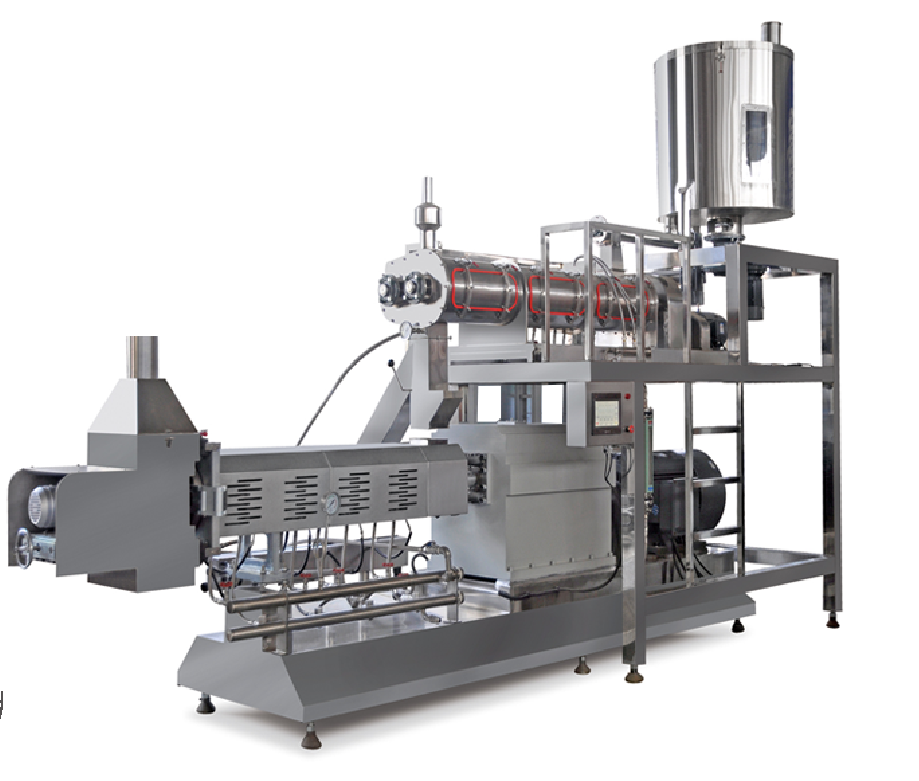
Processing sticky, chunky, or high-protein formulations on a standard twin-screw line often turns into a fight against barrel buildup, surging feed zones, and heat damage. The screw configuration has to be built around the material instead of forcing the material into a general-purpose profile. Shallow kneading blocks placed later in the barrel, coupled with deeper conveying elements up front, let larger particulates pass through without being pulverized while still generating enough distributive mixing to coat every chunk with melt.
High-protein blends tend to seize up when shear and barrel temperatures climb too fast. A useful setup runs a shorter high-shear section near the die and relies on lower-temperature conveying zones earlier in the barrel. This keeps protein from denaturing into a hard, dry mass and helps sticky dough release from the screws. Cooling the feed throat and using side stuffing for fragile inclusions also makes a noticeable difference with mixes that would otherwise ball up around the screws.
Venting and pressure control matter just as much as temperature. Chunky or wet blends trap air and moisture, so moving the atmospheric vent downstream of the main mixing section prevents material from being pushed out through the vent. A slight vacuum at the final section strips residual moisture without collapsing the product structure, which is often what separates a clean, open texture from a dense, smeared melt.
High-Moisture Extrusion’s Pull Toward Fibrous, Sliceable Bites
High-moisture extrusion has a way of turning dense plant protein into something with direction. Instead of a uniform paste, the material moves through the cooling die in overlapping streams, and those streams set into thin, visible fibers that pull apart along natural seams. That grain is what lets a slab cut cleanly into deli-style slices or tear into shreds without crumbling at the edges.
The pull toward fibrous, sliceable bites comes down to how the process handles water. Under high moisture, the protein unfolds and realigns under shear, then the sudden temperature drop in the die locks that alignment before it collapses. Tweak the moisture level or the cooling profile, and the fibers shorten into tender flakes or lengthen into chewier strips. It is a narrow window, but when it works, the result feels less like extruded paste and more like something with bite, resistance, and give.
Low-Shear Dies That Help Airy Snacks Hold Their Shape
In airy snack production, the die is less about brute shaping and more about managing how the melt releases pressure. Low-shear designs let the dough expand gradually instead of ripping through the exit, so thin walls and hollow sections keep their intended shape. The result is a snack that holds a defined ring, tube, or pillow profile rather than slumping into an irregular mass.
A lot of that stability comes from longer, smoother land areas and carefully radiused flow channels. They even out the velocity across the profile, which reduces weak seams and uneven thickness. Because the starch matrix stays intact during the pressure drop, steam bubbles form in a controlled way, giving the final texture a light crunch without sacrificing edge definition.
These dies also prove forgiving when conditions shift slightly—moisture, temperature, or line speed. Since less shear means less localized heat and degradation, the dough exits cleanly and the shape remains repeatable. Operators spend less time fighting dimensional drift, and the finished pieces move through seasoning and packaging with fewer crushed edges.
Co-Extruded Fillings and the Mid-Bite Flavor Shift
The moment your teeth sink through the outer shell of a co-extruded snack, the flavor journey begins with a familiar top note. But the real surprise lands halfway through the chew, when the inner filling finally breaks free of its casing. That mid-bite shift isn't an accident of manufacturing; it's a deliberate layering of texture and taste that turns a simple bite into a two-act performance.
Co-extrusion works by forcing two or more materials through a single die at the same time, creating a continuous rope with a distinct core and shell. What matters for flavor isn't just what goes into the filling, but how the shell delays its release. A thicker, slower-dissolving outer layer buys you a few extra seconds of anticipation, while the filling's viscosity controls whether it floods the palate all at once or seeps out gradually. That timing is what separates a flat, single-note snack from one that keeps your attention from first crunch to final swallow.
Snack developers play with this delay the way a pastry chef layers jam inside a croissant. A bright, acidic fruit gel can hide behind a buttery, savory shell, only to cut through the richness at the exact moment the jaw starts to tire of the same texture. Likewise, a cool mint or chili heat tucked into a neutral base can reset the palate mid-chew, making the next bite feel almost like a first bite again. The mid-bite flavor shift isn't just a novelty; it's a tool for extending the sensory arc of a snack without changing its overall shape or size.
Choosing Hot-Cook or Cold-Form Setups Before the Die
The decision between a hot-cook and cold-form setup usually comes down to how the material behaves under pressure and temperature long before tooling enters the picture. Running a hot-cook line means accounting for thermal expansion, faster material flow, and a shorter window for holding tolerances. Shops that lean this way often do it because the part needs deep draws or complex contours that would tear at ambient temperature.
Cold-form work carries a different set of trade-offs. Without added heat, the blank keeps more of its original grain structure and surface finish, which helps when dimensions are tight and secondary finishing needs to stay minimal. The challenge is that tooling takes more abuse, so die materials, coatings, and lubrication have to be chosen with that in mind.
What trips people up is treating the choice as purely technical. Floor experience, available press capacity, and how consistently the incoming stock behaves often matter more than the ideal process on paper. A quick trial run with a limited batch will usually reveal whether the heated setup is buying enough formability to justify its extra handling and energy cost, or whether a cold-form approach can hold the shape without overworking the die.
FAQ
The single-screw machine relies on one rotating screw inside a heated barrel to push and cook the material, which keeps it simpler to run and cheaper to maintain. Twin-screw extruders use two intermeshing screws that move product forward more positively, so wet, sticky, or high-fat recipes don't slip as easily. That extra control makes twin-screw systems the usual pick for meat analogs, high-moisture pet foods, and formulas that need tight residence time.
Co-rotating twin-screw extruders tend to dominate this space. Their screws turn in the same direction and can be configured with mixing, kneading, and reverse elements along the barrel, giving the long cooling and shear control needed to align plant proteins into fibrous layers. Without that controlled cooling die and screw profile, the texture ends up pasty rather than resembling pulled meat.
Yes, mainly where gentle, intermittent flow is an advantage. They work by pushing dough through a die with a ram, so there is far less shear than screw-based machines. This makes them useful for soft doughs, some filled snacks, confectionery masses, and laboratory-scale product development where you need to switch formulas quickly without cleaning a long barrel.
Cold extrusion shapes a product without significant added heat; most of the temperature comes from friction or is kept deliberately low. It fits products that must stay structurally intact, like pasta, some biscuits, and certain doughs, where cooking happens later by boiling, baking, or frying. Hot extrusion cooks while it shapes, so it is chosen for expanded snacks, breakfast cereals, and pregelatinized ingredients that need starch transformation inside the barrel.
A high-shear cooking extruder, most often a single-screw system for straightforward corn- or rice-based recipes. The screw compresses the moistened grain mix, steam or barrel heating brings the mass above boiling point, and the pressure drop at the die flashes moisture into vapor, puffing the product. Twin-screw versions appear when the recipe includes more oil, sugar, or inclusions that would cause a single screw to back-mix or stall.
Low-shear designs are used when the recipe must stay dense, uniform, and easy to absorb water without excessive expansion. They usually run at lower screw speeds and cooler barrel profiles, producing pellets that sink or remain stable in liquids rather than float. This matters for many aquaculture feeds and some pet diets where controlled density and durability during transport outweigh the need for a puffed texture.
The main difference is shear and pumping style. Co-rotating screws are favored for high-shear cooking, mixing, and reactive or texturizing processes because they create strong kneading zones. Counter-rotating screws generate a more positive, gear-like pumping action with lower shear, which suits heat-sensitive materials, gentle conveying, and some forming applications. Recipe viscosity, desired texture, and how much mechanical energy the product can tolerate usually decide the better fit.
Conclusion
Modern food extrusion is less about finding one universal machine and more about matching screw configuration, shear, and die design to the way a specific dough or protein slurry behaves under pressure. Single-screw lines still earn their place in bakeries and snack plants where straightforward cereal or potato doughs need steady, cost-conscious throughput. They do not offer the intense mixing of larger systems, but that is precisely why they work well for simple formulations that would become overworked or sticky with too much mechanical input. When recipes turn sticky, chunky, or heavy with protein, twin-screw extruders take over. Their intermeshing screws move materials more evenly, tolerate higher moisture and fat variation, and let operators adjust barrel temperature and screw speed without sacrificing consistency.
Texture and structure increasingly come from the die end and the thermal route chosen before it. High-moisture extrusion has drawn attention for producing fibrous, sliceable bites that resemble pulled meat, especially from soy, pea, or wheat proteins, because the long cooling and laminar flow align proteins under moisture. Low-shear dies are then used to protect delicate, airy snack shapes, keeping gas cells intact so puffed corn or rice does not collapse into a dense pellet. Co-extrusion adds another layer by injecting fillings such as chocolate, fruit paste, or cheese into a crisp outer shell, shifting flavor in the middle of a bite instead of at the surface. Deciding between a hot-cook or cold-form setup matters too. Hot-cook systems gelatinize starches and develop browned notes before the die, while cold-forming retains sensitive ingredients and can yield a cleaner, more controlled shape.
Contact Us
Contact Person: LILY SUN
Email: [email protected]
Tel/WhatsApp: 0086-13969103791
Website: https://www.snackfoodmachinery.com/