

LED Marine Light Wholesale Guide to Choosing Durable Navigation Lighting for Commercial Boats
2026-11-25
On commercial water, a navigation light isn't a detail—it's the difference between being seen and being struck. Yet too many wholesale buyers still chase the cheapest LED fixtures and end up replacing corroded housings season after season. This guide breaks down what actually makes marine navigation lighting durable enough for working boats, and why fleets that switch to LUXFIGHTER stop treating lights like disposable parts.
Where Commercial LED Navigation Lights Fail First
Failures rarely begin at the diode. On commercial vessels, the earliest trouble tends to appear where the housing meets the lens and where the cable enters the fixture. Repeated heating and cooling works these seals until a fine gap opens, allowing salt-laden air to pull inside. Once the driver cavity starts breathing damp air, corrosion settles on the board and terminals, often months before the lamp gives any visible warning.
Loose terminations are another weak link that shows up early. Constant vibration from engines, shaft lines, and hull slap works screws and crimps apart by tiny degrees. The connection develops resistance, runs warmer than the surrounding wire, and eventually starts to flicker or drop out entirely. Because the symptom looks like a failed LED, maintenance crews sometimes replace the wrong part and leave the real fault waiting in the harness.
Lens condition also deserves closer attention than it usually gets. Polycarbonate and acrylic covers develop fine cracks and surface haze after prolonged UV exposure and salt spray. The lamp may still pull current and look bright at close range, but the effective visibility distance can fall below the required standard without triggering any alarm or indicator on the bridge.
Corrosion Resistance Beyond the Spec Sheet
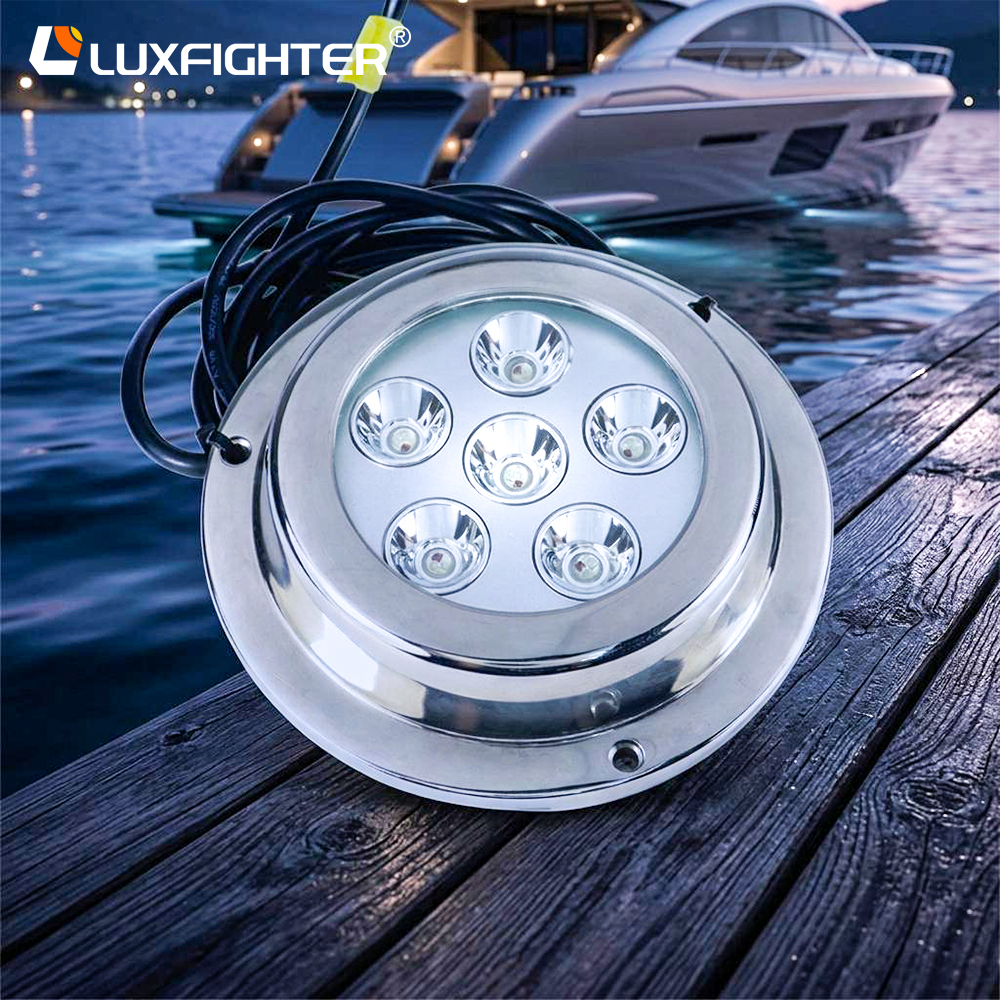
Standard corrosion ratings rarely tell the full story once a component leaves the lab. Salt spray hours and passivation certificates look reassuring on paper, but real exposure involves temperature swings, crevice geometry, and contact with mixed media that no single accelerated test reproduces. I have seen stainless steel fasteners pass a 1,000-hour fog test, then show pitting within six months in a coastal installation where chloride laden wind combined with sheltered, unwashed surfaces. The gap between spec sheet and service life comes down to details that are almost never captured in a catalog number.
One underappreciated variable is surface finish. A rough, torn thread root or a rolled edge left with micro burrs can trap moisture and create oxygen concentration cells that initiate attack even in alloys considered highly resistant. Likewise, assembly stress matters. Residual tension in a bolt, a slight mismatch in mating flanges, or a seal groove machined a few microns too deep can tilt the balance from passive film stability to localized breakdown. These are the conditions that distinguish a material that merely passes a test from one that stays clean and functional after years of thermal cycling and intermittent wetting.
A more useful approach asks what happens after the test ends. Does the passive layer reform uniformly after a scratch? How does the component behave at the interface with a different metal, a gasket, or a weld heat affected zone? By looking at corrosion resistance as a system property rather than a single alloy rating, engineers can avoid surprise failures that no data sheet would ever predict. The goal is not to chase a higher number on a report, but to design for the specific, messy conditions the part will actually live in.
Waterproofing That Survives Pressure Washers and Storms
Most waterproofing claims fall apart the moment a pressure washer gets close. Real protection doesn’t sit on the surface waiting to be blasted off—it gets pulled into the pores and locks there. When water hits at 2,000 psi or a storm drives rain sideways for hours, that difference decides whether the wall stays dry or quietly starts rotting behind the siding.
The weak points are rarely where people look. Hairline cracks, joint movement, and the bottom edge where splashback soaks upward all fail before the flat surface does. A treatment that stays flexible after curing moves with the structure instead of cracking against it. That flexibility also shrugs off the repeated impact of high-pressure spray, because the coating isn’t rigid enough to chip away.
Storms bring a different problem: prolonged saturation. Water creeping into microscopic gaps eventually finds a path through if the barrier is shallow. Deep penetration matters more than a thick film on top—film peels, penetration stays. When both a pressure washer test and a full day of wind-driven rain leave the surface unchanged, the waterproofing stops being a maintenance chore and becomes part of the building.
Matching Light Output to Real-World Watchkeeping
On a darkened bridge at 02:00, a watchkeeper’s eyes have adjusted to near-total darkness. A light source that glows too brightly erases that adaptation in seconds and forces several minutes of recovery. The output here is not a marketing number; it is a working threshold. Illumination tuned for real watchkeeping sits just above legibility, enough to read instruments without flooding the immediate area and destroying the watchkeeper’s night vision.
Real-world watchkeeping rarely offers stable lighting. A chart table may be half-lit by a red lamp, while the open wing bridge carries moonlight and occasional deck-light spill. Matching output means the light should stay readable against these mixed sources without becoming a distraction. It also means avoiding sudden jumps between dim and bright modes when a user shifts position or glances between tasks.
The useful measure is not maximum brightness but how the light behaves after the eyes have settled into night vision. A lower, warmer output can outperform a brighter, colder one because it preserves the ability to scan an instrument and then look back out to sea without delay. That is the difference between lighting that looks impressive in daylight and lighting that actually works during a watch.
Voltage Spikes, Battery Banks, and Wiring Realities
When a battery bank gets hit with voltage spikes, the usual wiring diagrams start to look optimistic. The inductance in long cable runs can turn a quick load dump or inverter shutdown into a sharp transient that the batteries feel before any protection circuit reacts. It is not just about the cells themselves; the physical layout, the crimp quality, and the path the current takes all determine whether that spike gets absorbed or finds a weak point.
Battery banks do not share current as evenly as spec sheets suggest. Slight differences in internal resistance or cable length let one string work harder, and a spike can push that imbalance further. Running equal-length cables and bus bars with proper torque helps, but real-world installs often have to compromise around enclosures, vents, and service access. Those compromises show up as hotter connections and occasional nuisance trips.
Wiring realities mean you plan for what you cannot see on a meter. Twisting pairs, keeping sense leads away from power cables, and adding a low-ESR capacitor bank close to the inverter can flatten transients before they reach the cells. If the system relies on a BMS alone to catch everything, the wiring has already decided how much damage is possible.
Calculating the Real Service Life Before You Stock Inventory
Parts rarely fail according to the printed datasheet. A rated life often assumes clean conditions, steady load, and disciplined maintenance, but a bearing on a line that starts and stops every shift or a seal in a dusty plant can wear out much sooner. Before committing shelf space and capital, pull actual removal dates, work order notes, and failure modes from your own maintenance records. Group similar assets by operating context rather than model number alone, and you will get a realistic life band instead of a single manufacturer figure.
Once the history is assembled, look at the distribution of time between replacements rather than averaging it. A few early failures can drag a simple mean down and lead to overstocking. A percentile view helps more: what life do 80% of units reach, and what happens in the worst 10%? That spread matters because the reorder point has to cover early failures, not the lucky survivors.
Treat the calculated life as a living number. Update it after a new failure, a relocation, or any change in duty cycle. A belt that lasts two years in a clean room may not do the same next to a shot blaster. Recalculating quarterly or after maintenance changes lets you hold fewer units while still avoiding downtime, leaving you with a lean spares shelf built on observed behavior instead of guesswork.
FAQ
Forget raw brightness for a moment. The housing material and sealing matter more. Anodized aluminum or a strong marine polymer resists salt corrosion, while potted electronics and sealed wiring prevent water intrusion. If the mounting points and lens are not built for constant vibration, the light will fail long before the LEDs wear out.
Ask the supplier for certification documentation, not just a spec sheet. The approval should state the vessel size, placement, and required visibility range in nautical miles. If they cannot produce that, the light is probably not suitable for inspected commercial operations.
By visible range. A well-focused optic can place more usable light on the horizon than a brighter but scattered source. Request photometric data showing intensity at the required angles instead of relying on a raw lumen figure.
IP67 means it can survive temporary immersion under defined conditions. IP68 usually implies the maker tested it beyond that, often with a specified depth and duration. On a commercial boat that takes spray and occasional green water, a properly sealed IP68 unit with a watertight cable gland offers a meaningful safety margin.
Only if the terms are specific. A warranty that covers corrosion, lens yellowing, and lumen loss for several years tells you more than one that only replaces dead-on-arrival units. Read the fine print and ask how claims are handled before committing to a large order.
Usually the driver, the connector, or the housing around the mounting holes. Fogged or crazed lenses are also common after sun exposure. Many failures appear after one season, which is why cheap fixtures become expensive once labor and downtime are included.
Yes. Commercial boats run longer hours, face more vibration, and undergo stricter inspections. That usually means lights with thicker housings, continuous-duty ratings, better thermal management, and available spare parts rather than the lighter designs sold for weekend use.
Conclusion
Most failures on commercial LED navigation lights start well before the diode itself gives out. Housings crack at mounting points, cable glands loosen, and moisture creeps into drivers that were never sealed for the way workboats actually get washed. A spec sheet may mention anodized aluminum or marine-grade stainless, but corrosion resistance has to be judged by how the fixture handles mixed metals, salt-laden air, and constant vibration. Pressure washers and heavy weather expose weak seals faster than any lab test. The useful question is not whether the light meets an IP rating on paper, but whether water stays out after a year of thermal cycling and dockside cleaning.
Light output matters less as a listed lumen number and more as something a watchkeeper can use without glare or dead zones. Commercial vessels run on messy electrical systems, so the fixture needs to tolerate voltage spikes, uneven battery banks, and wiring that is rarely as clean as the installation diagram. Before stocking inventory, wholesalers should calculate the real service life based on driver reliability, replacement part availability, and how the light behaves after the warranty ends. It is the difference between a cheap unit that fails mid-season and a fixture that stays boringly reliable for years.
Contact Us
Contact Person: Gavin Chen
Email: [email protected]
Tel/WhatsApp: (+86)756-6831079
Website: https://www.luxfighter.com/