

Non Oriented Electrical Steel Factories and Their Role in Energy Efficient Motors
2026-08-14
At the heart of every high-efficiency motor lies a material often overlooked: non-oriented electrical steel. While design and control electronics grab headlines, it's the grain structure and magnetic properties of this specialized steel that determine how much energy becomes motion and how much is lost as heat. As global efficiency standards tighten, the role of advanced non-oriented electrical steel factories—like Jiangsu Baowu New Materials—has never been more critical. This post explores how these facilities are quietly reshaping the future of energy-efficient motors.
Inside a Non-Oriented Electrical Steel Factory: From Slab to Lamination
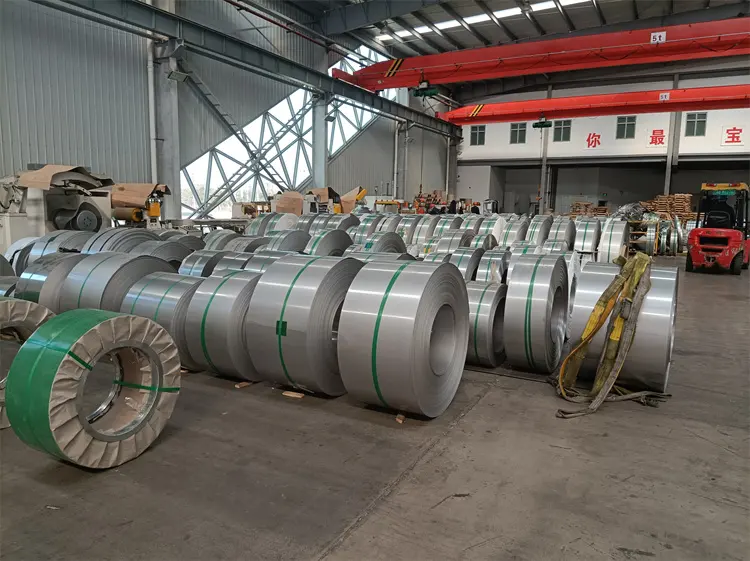
Walking through a non-oriented electrical steel mill, the process starts with thick cast slabs that have already been surface-ground to remove scale and cracks. These slabs are reheated in a walking-beam furnace, then pushed through a roughing mill where the thickness drops from around 200 mm to a transfer bar of 25–35 mm. What stands out is how carefully the mill operators watch the finishing temperature—non-oriented grades need a controlled hot-rolling schedule so that the grain structure stays uniform and does not develop a strong rolling texture too early.
After hot rolling, the strip is pickled to remove the oxide layer, then cold rolled to its final thickness, often in the range of 0.35–0.65 mm. The cold-rolled coil then enters a continuous annealing line where decarburization and grain growth happen at the same time. The atmosphere inside the furnace is a precise mix of hydrogen and nitrogen, and the line speed is adjusted to keep carbon below 0.005% while allowing enough time for grains to grow. This is the stage where the magnetic properties are largely set—too little decarburization and the core loss climbs, too much grain growth and the material becomes mechanically weak.
Finally, the annealed strip receives a thin insulating coating that also acts as a carrier for tension, then it is slit to the required width and blanked or laser-cut into laminations. The finished laminations are stacked in bundles, and you can feel the difference from the original slab—the surface is smooth, the edges are clean, and each piece is light but uniform. Every step from slab to lamination is aimed at reducing core loss and improving permeability, which is why these factories pay so much attention to small changes in temperature, speed, and atmosphere.
Core Loss: The Quiet Thief of Motor Efficiency
Every motor hums with hidden losses, but few drain efficiency as silently as core loss. It happens inside the iron laminations, where alternating magnetic fields constantly realign tiny magnetic domains. Each flip costs a bit of energy, released as heat you rarely notice until the motor runs hot or the power bill climbs. Unlike friction or windage, this thief leaves no obvious sign—no grinding parts, no rushing air—just a slow, steady bleed of performance.
Engineers often chase bigger wins in winding design or bearing friction, while core loss nibbles away in the background. The culprits are hysteresis and eddy currents: one from the magnetic material stubbornly resisting change, the other from loops of current swirling inside the steel itself. Thinner laminations and better alloys help, but the choice of operating frequency and flux density matters just as much. Pushing a motor a little harder can make these invisible currents surge, turning a few percentage points of loss into real heat that shortens insulation life.
The result is a motor that meets spec on paper yet falls short in the field—warmer, less responsive, and more expensive to run. By measuring input power against mechanical output across different speeds and loads, you can spot the quiet thief at work. Once identified, it's often a matter of adjusting the drive settings or specifying a better grade of lamination steel, not redesigning the whole machine. Small changes there bring back efficiency that was never really lost, just borrowed by the magnetic core.
How Silicon Content and Grain Size Shape Magnetic Performance
Silicon content resets the intrinsic magnetic trade-offs. Raising silicon from 0.5% to about 3.2% nearly doubles electrical resistivity, which suppresses eddy current loss in AC machines. The same addition dilutes iron, pulling saturation magnetization down from roughly 2.15 T to below 2.0 T. Silicon also lowers magnetocrystalline anisotropy and magnetostriction, so hysteresis loss improves, but beyond about 3.5% the alloy becomes too brittle for reliable cold rolling.
Grain size mainly controls how easily domain walls move. Coarse grains in the 100–200 µm range reduce grain boundary area, giving domain walls fewer pinning sites and lowering hysteresis loss. Yet grain growth is not a free pass: excessive grain size can promote unfavorable crystallographic texture and reduce mechanical strength. In some grades, very large grains also raise magnetostriction-related acoustic noise despite lower hysteresis.
The practical balance shifts with operating frequency. At 50–60 Hz, hysteresis loss dominates, so larger grains and moderate silicon give the best result. Above roughly 400 Hz, eddy current loss grows fast, and higher silicon content plus thinner laminations become more important than further grain enlargement. A common compromise pairs 2.5–3.2% silicon with controlled grain growth to keep total loss low across a useful frequency range.
Coating Choices That Cut Eddy Current Losses Without Adding Bulk
Thin phosphate and oxide layers remain the workhorses here—often just a few microns thick, they interrupt interlaminar eddy paths without changing stack dimensions. A standard silicon steel lamination with an inorganic phosphate coating can cut core loss by raising interlaminar resistance while keeping the same slot fill.
Polymer-based coatings, including epoxy and polyimide variants, let designers tune resistivity across a wider range. Because these films can be applied at controlled thicknesses from 2 to 10 µm, they suppress high-frequency eddy currents in smaller cores without forcing a redesign of the winding window.
Some manufacturers also turn to hybrid coatings that combine an inorganic base layer with a thin organic topcoat. The base provides thermal stability during annealing, while the topcoat improves adhesion and protects against moisture—so the coating stays effective without adding measurable bulk to the lamination stack.
Why Inverter-Driven Motors Demand Different Steel Grades
Inverter-driven motors operate on pulse-width modulated waveforms rather than clean sinusoidal power. These waveforms are rich in high-frequency harmonics that penetrate the stator laminations and induce eddy currents and hysteresis losses well beyond what standard electrical steels encounter at 50 or 60 Hz. The result is localized heating, reduced efficiency, and accelerated insulation aging if the steel grade is not selected with these harmonic spectra in mind.
To counter this, motor manufacturers turn to thinner-gauge laminations with higher silicon content or specialized insulating coatings. Thinner sheets cut eddy-current paths, while increased silicon raises electrical resistivity and lowers hysteresis loss. Some grades also feature improved surface insulation to withstand the voltage spikes and partial discharge risks common in inverter-fed machines. These properties allow the core to handle harmonic-rich flux without excessive temperature rise.
Beyond losses, inverter excitation produces non-sinusoidal flux density patterns that can drive the steel into local saturation, increasing magnetostriction and audible noise. A dedicated inverter-duty steel grade balances magnetic isotropy and mechanical strength, reducing vibration while maintaining dimensional stability under thermal cycling. This combination helps the motor deliver stable torque and longer service life in variable-speed applications.
Thinner Laminations, Better Motors: The Push for Higher Silicon Alloys
Motor cores are stacked from individual steel sheets, and the thickness of those sheets sets a hard limit on how much energy gets lost as heat. Standard laminations run around 0.35 mm to 0.50 mm, which is fine for line-frequency machines but starts to bleed efficiency once a drive pushes the fundamental frequency into the hundreds of hertz. Going thinner cuts the cross-sectional area where eddy currents circulate, so the losses drop faster than most design tweaks can manage.
That alone would be enough motivation, but the real leverage comes from adding more silicon to the steel. A jump from the usual 2–3% silicon toward 6.5% roughly doubles electrical resistivity, which suppresses eddy currents further and also trims hysteresis loss. The downside is workability: high-silicon alloys turn brittle and resist the rolling processes used to make thin strip. Manufacturers have sidestepped this with vapour deposition and powder metallurgy, but those routes cost more and demand tighter process control.
The payoff shows up in high-speed spindles, EV traction motors, and aerospace generators, where a core that runs cooler can be pushed harder without derating. Lamination thickness alone isn't a silver bullet—stacking factor and insulation coating matter just as much—but paired with higher silicon content it shifts the loss curve enough to change what a motor can sustain at speed.
FAQ
Because this steel grade has isotropic magnetic behavior, meaning it performs consistently in all directions. Motors need that multidirectional flux handling, and higher grades cut core losses dramatically, which is exactly where efficiency gains come from.
Look beyond just price. Consistent gauge control, clean steel chemistry with low impurities, reliable insulation coatings, and a track record of tight core loss tolerances matter more in the long run.
Higher silicon raises resistivity, which suppresses eddy currents and lowers core loss. But too much makes the steel brittle and harder to punch. Most motor grades balance around 1% to 3.5% silicon.
The coating prevents interlaminar eddy current flow between stacked laminations. Without a good coating, the motor would run hotter and lose efficiency, even if the base steel is high grade.
They don't just test the steel in isolation. Epstein frame tests and single sheet testers measure core loss and permeability at specific frequencies and flux densities, giving a realistic picture of how the material behaves inside a rotating machine.
It's possible but much harder. Lower grades have higher core losses, so the motor designer has to compensate with more copper, larger frames, or better cooling. High-efficiency targets are far easier to hit with premium steel.
Hot rolling, cold rolling reduction, and final annealing are critical. The annealing atmosphere and cooling rate determine grain size and texture, which directly affect core loss and permeability.
Yes, factories are pushing thinner gauges like 0.20 mm or 0.15 mm, using cleaner scrap and tighter process control to reduce losses at higher frequencies, which is essential for EV traction motors and high-speed applications.
Conclusion
Walking through a non-oriented electrical steel mill, the transformation from thick slab to thin lamination is a careful balance of chemistry and rolling schedules. The goal is not just uniform thickness but a consistent magnetic behavior in every direction. Core loss, that quiet thief of efficiency, starts at the casting stage; even subtle variations in grain size or internal stresses can add up as heat instead of torque. Mills tune silicon content and processing temperatures to refine grain structure, aiming for lower hysteresis and eddy current losses without making the strip too brittle to punch. Modern surface coatings also play an underappreciated role: a thin, tightly bonded insulation layer reduces interlaminar eddy currents, yet it must survive stamping, welding, and thermal cycling without cracking.
The rise of inverter-driven motors has forced factories to rethink grade design. High-frequency harmonics punish conventional steels, so premium alloys with higher silicon and reduced thickness are now standard for many premium efficiency lines. Thinner laminations shrink eddy current cross-sections, while higher silicon lifts electrical resistivity, but both make manufacturing harder, requiring specialized rolling and annealing. In practice, a factory's value lies in controlling these variables at scale: keeping tolerances tight, adapting coatings to end-use, and developing grades that pair mechanical punchability with magnetic consistency. Without that behind-the-scenes work, even the cleverest motor design remains short of its efficiency potential.
Contact Us
Contact Person: Zoe Liang
Email: [email protected]
Tel/WhatsApp: 86 189 2128 6299
Website: https://www.baowuchina.com