

NS3304 Seamless Pipe Factory Crafting Durable Corrosion-Resistant Tubing
2026-11-16
Corrosion doesn’t send a warning. One day the pipe wall is thick enough; the next, it’s leaking under pressure. That’s exactly where NS3304 seamless pipe earns its reputation. In the JILAIDA factory, this advanced nickel alloy is drawn and pierced into seamless tubing with a single goal: keep aggressive media contained for years, not months. We’re not interested in selling you a commodity—we build the corrosion-resistant backbone your toughest systems are missing. Read on to see how our NS3304 seamless pipe production breaks away from the usual shortcuts.
Where NS3304 Seamless Pipes Take Shape
NS3304 seamless pipes begin as solid round billets from vacuum induction melting. The billets are heated in a rotary hearth furnace to a narrow band between 1160°C and 1190°C, then pushed by a horizontal extrusion press through a die and over a mandrel to form the initial hollow shell. This step is never aimed at final dimensions; it breaks down the cast structure and leaves enough deformation allowance for the cold working that follows.
The real dimensional control happens on cold pilger mills. The shell is slipped over a long mandrel and squeezed repeatedly by grooved rolls that rotate and reciprocate, reducing wall thickness and stretching length with each pass. After every pass the tube becomes harder, so intermediate annealing is needed to restore ductility. Operators here rarely rely on feel; they watch laser micrometers and wall-thickness feedback, adjusting feed rate and turn angle within the tolerance band.
Once shaped, the pipes go through bright annealing, straightening, and cut-to-length sawing. Every single pipe is then subjected to hydrostatic testing and ultrasonic inspection. Only batches free of cracks, laminations, and laps on both inside and outside surfaces receive their heat number stencil and protective wrapping. No step in this sequence is symbolic—any parameter drift will show up in the final test data.
Alloy Chemistry That Laughs at Salt Spray and Acid
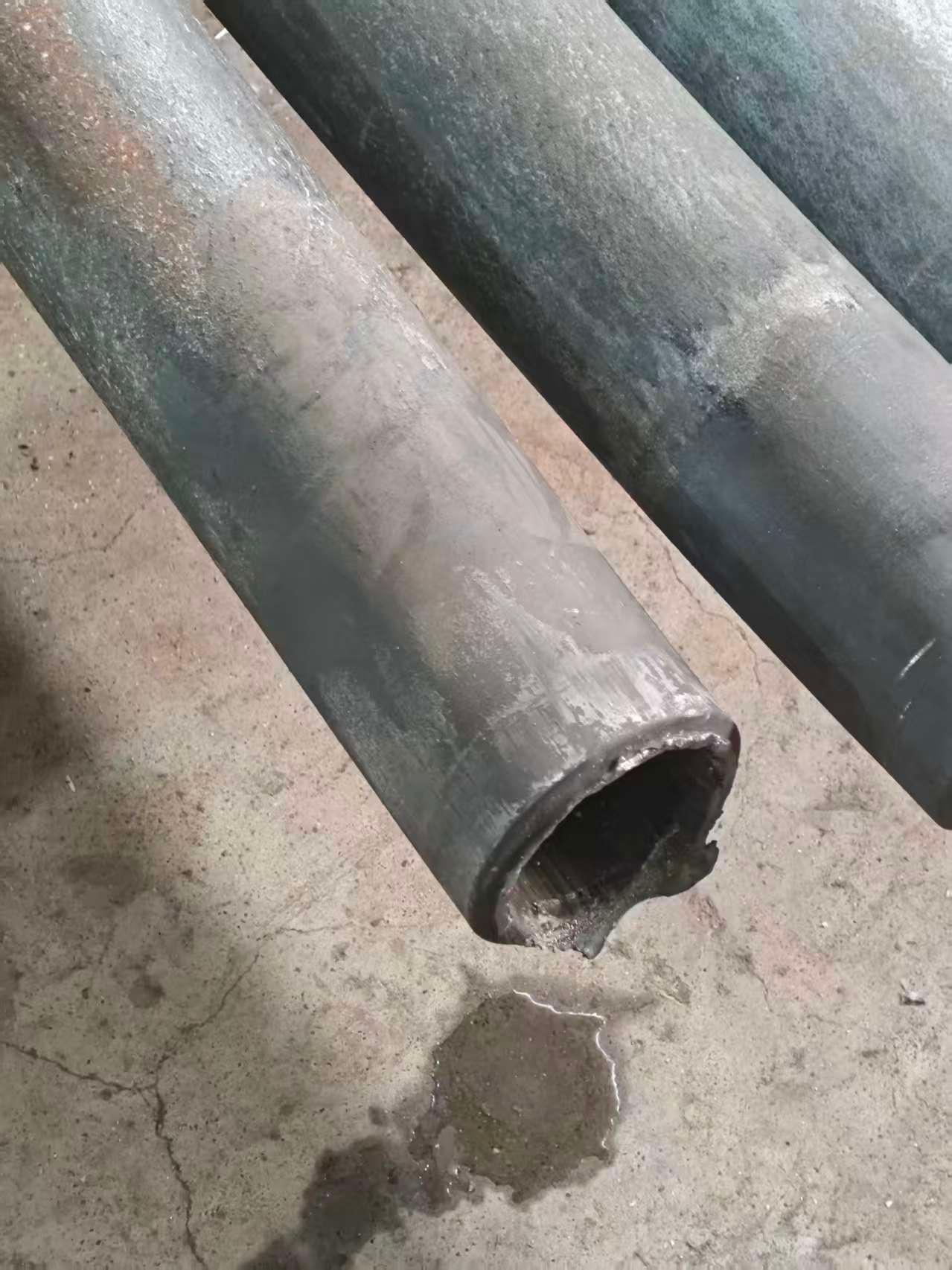
Most corrosion-resistant alloys rely on a passive oxide layer that forms quietly on the surface. But the alloys we’re discussing here don’t just form that layer—they rebuild it on the fly, even when salt spray or acid tries to strip it away. The trick lies in carefully balancing chromium, molybdenum, and sometimes tungsten, so that the metal’s own chemistry becomes aggressively self-healing. Instead of merely tolerating harsh environments, these materials treat chloride attack as a minor inconvenience.
What makes the difference is not just the percentage of each element, but how they interact at grain boundaries and within the matrix. High molybdenum content, for example, pushes the pitting resistance equivalent number far beyond standard 316 stainless. In practice, that means a fitting or flange made from such an alloy can sit in a marine atmosphere or a chemical plant’s acid line for years without developing the telltale rust blooms or pinhole leaks. Salt spray tests that would eat through ordinary steel in hours leave these surfaces with little more than a dull sheen.
Of course, the real laughter comes from the maintenance budget. Where other metals demand coating touch-ups, cathodic protection, or replacement, these alloys simply shrug off the insult. Engineers who’ve switched to them often report that the biggest challenge is convincing new team members the equipment hasn’t been recently painted—it really is just bare metal doing its job. That’s the beauty of alloy chemistry tuned not for the lab, but for the world’s nastiest corners.
The Hidden Steps Behind a Flawless Tube Surface
Most people assume a smooth metal tube comes straight off the mill, but the real work happens in a series of quiet, unglamorous steps. After forming and welding, the surface carries mill scale, oxide patches, and faint tool marks that are invisible at arm's length yet glaring under magnification. The first hidden stage is mechanical descaling, where fine abrasive brushes or belt grinders work along the tube's axis, removing brittle scale without cutting into the base metal. Operators adjust pressure by hand and ear, listening for the subtle change in pitch that signals a clean pass.
Next comes the chemical bath, often a heated pickling solution that lifts residual oxides from the weld zone and heat-affected areas. This step is less about shine and more about creating a uniform, passive surface that resists corrosion. Tubes are racked at specific angles so air pockets don't trap acid, and immersion times are kept short enough to avoid pitting. Rinsing follows immediately, with deionized water to prevent water spots that would later show up as dull streaks.
The final hidden step is inspection under raking light. A skilled technician runs a gloved hand along the length while a low-angle lamp throws shadows across any ripple, scratch, or embedded grit. Flaws that pass visual checks are caught by touch or by a quick pass with a profilometer. Only after this quiet sequence does the tube earn its flawless look—a surface that seems effortless because every trace of effort has been removed before it leaves the floor.
What Happens When a Pipe Refuses to Crack
When a pipe refuses to crack, the pressure doesn't simply vanish. It accumulates silently along the walls, seeking the weakest joint, the oldest thread, the smallest corrosion pit. What engineers often overlook is that a pipe that holds is not necessarily a pipe that is healthy. It may be storing stress like a coiled spring, waiting for a temperature shift or a water hammer to release everything at once.
In older plumbing systems, this stubbornness can be more dangerous than a visible leak. A small crack gives you a warning, a drip, a stain on the ceiling. But a pipe that refuses to crack offers no such courtesy. It fails suddenly, often at the most inconvenient hour, turning a minor repair into a flooded basement.
There is also a material science angle: ductile pipes deform before breaking, giving visual clues, while brittle pipes can shatter without warning. The refusal to crack may come from internal residual stresses or from a support bracket that prevents movement. In any case, the lesson is simple: pressure always finds a way out. The pipe that will not crack has merely chosen a different exit.
Matching Odd Specifications Without Slowing the Line
Odd specs used to mean pulling a job off the line, walking it through a separate process, and losing the rhythm that keeps the rest of production moving. The better approach is to design flexibility into the standard flow rather than treating exceptions as interruptions. That can mean quick-change fixtures, adjustable guides that lock in place with a single lever, or a small pre-staging area where uncommon components are kitted before the line ever reaches them.
What really keeps the line from slowing is giving operators a clear trigger for when a spec falls outside the normal range, and a predetermined path to handle it without stopping upstream work. A short visual reference at the station, color-coded trays for nonstandard parts, or a dedicated side lane that merges back in after the odd unit is complete all preserve cadence. The result is that a custom order gets built with the same steady beat as a high-volume run, just with a few extra handoffs that nobody has to think about twice.
Traceability From Heat Number to Final Hydro Test
Each pipe starts its record with a heat number stamped at the mill, tying the raw steel to a specific batch of chemistry and rolling parameters. Rather than treating this as a simple label, the system links that identifier to every downstream process: forming, welding, heat treatment, and non-destructive testing. The goal is to create a living thread that follows the material through dimensional checks and pressure retainment steps, so any anomaly spotted later can be walked back to its exact metallurgical origin without ambiguity.
When a pipe reaches the hydrostatic test bay, the operator scans the heat number printed on the OD or etched near the bevel. The test record then captures not just pass or fail, but also the test pressure, hold duration, gauge calibration details, and even the technician’s sign-off. If the pipe is destined for a sour service or subsea line, supplemental traceability notes tie in the heat-specific charpy results or hardness readings collected earlier, giving the hydro test a broader context than a simple leak check.
At final document handover, the traceability file assembles into a single chain: heat number, mill certificate, weld map, NDT reports, and the hydro test chart. This approach departs from bundling multiple heats into one generic lot. Instead, each pipe keeps an unbroken narrative from furnace to final pressure test, making it possible to answer questions like “Which heat did this joint come from?” in seconds, not days. That level of clarity matters when an operator plans a remedial cutout or a regulator asks for proof of pressure integrity years after installation.
FAQ
NS3304 is a nickel-base alloy with high molybdenum and tungsten content, giving it exceptional resistance to pitting, crevice corrosion, and stress corrosion cracking. The seamless construction eliminates weld seams, so there are no weak points where aggressive media can attack first.
You'll find them in flue gas desulfurization systems, chemical processing reactors, offshore oil and gas platforms, and pharmaceutical production lines. Basically anywhere chloride-rich or acidic conditions would destroy ordinary stainless steel.
Each heat goes through a battery of tests, including intergranular corrosion testing per ASTM G28, hydrostatic pressure checks, and full dimensional inspection. The mill also keeps traceability records from raw ingot to finished pipe, so every batch can be linked to its certified chemistry.
Yes, the factory runs multiple cold pilger mills and can produce outside diameters from 6 mm up to 323 mm with wall thicknesses down to 0.8 mm. Non-standard lengths and tighter-than-standard tolerances are available on request.
The product meets ASTM B622 / ASME SB622 for seamless nickel alloy pipe, along with relevant NACE MR0175 requirements for sour service. Third-party inspection by organizations like TUV or Lloyd's Register can be arranged.
Yes, it retains good mechanical strength up to around 1,000°F (538°C) in oxidizing atmospheres, though its sweet spot is in wet corrosion applications where acids and halides are present. For prolonged high-temperature exposure, specific heat treatment should be discussed with the mill.
They accept low minimum order quantities for prototype work, typically a few hundred meters depending on the diameter. You can request sample sections with mill test certificates before committing to a full production run.
Conclusion
Inside the NS3304 seamless pipe facility, each length starts as a carefully controlled melt rather than a generic steel billet. The alloy's nickel-chromium-molybdenum backbone is calibrated to shrug off salt spray and dilute acid, which matters more than any datasheet claim when pipes sit in coastal chemical plants or pickling baths. The team runs repeated draw cycles and intermediate annealing so grain structure stays uniform, then moves every tube through a multi-pass surface conditioning line. That step removes micro folds and scale pockets that would otherwise invite pitting. Operators check wall thickness and eccentricity after each pass, not just at final inspection, because a small drift early on becomes a weak spot under pressure. The result is a tube with a clean, almost polished inner bore that resists fouling and keeps flow rates stable over years.
Beyond standard schedules, the shop routinely handles odd outside diameters and non-typical wall combinations without slowing the line. Instead of retooling for each order, they use flexible mandrel sets and adjust cold-working sequences on the fly. A pipe that refuses to crack under thermal cycling or bending is not accidental; it comes from controlled sulfur and inclusion levels plus a final solution anneal that relieves residual stress. Every heat number is tracked from the initial ladle analysis through billet piercing, cold drawing, and the final hydro test. If a customer later finds an issue in the field, the factory can pull the exact mill records, test pressures, and operator notes for that specific length. This closes the loop between metallurgy and field performance, making NS3304 tubing a practical choice for corrosive, high-cycle service where downtime is expensive.
Contact Us
Contact Person: Chenji Li
Email: 521 Zhonghui Road, Huishan Economic Development Zone
Tel/WhatsApp: +86 83112233
Website: https://www.jldnickelalloy.com/