

Wholesale Surge Protective Device Solutions for Reliable Power Protection
2026-10-01
Electrical surges don't announce themselves. A nearby lightning strike, a switching operation at the utility, or even a large motor cycling on can send thousands of volts through your power lines in microseconds. For contractors and distributors who handle commercial and industrial projects, the difference between a minor hiccup and a catastrophic failure often comes down to one thing: the surge protective device installed upstream. That's why choosing the right wholesale surge protective device solution isn't just about meeting a spec—it's about buying peace of mind. At ETEK, we build SPDs that are designed to take the hit so your equipment doesn't have to. In the sections below, we'll dive into the features that matter, how to match protection levels to your site, and why ETEK's manufacturing approach gives you an edge in both performance and procurement.
Matching SPD Types to Your Distribution—Not the Other Way Around
When integrating surge protection into an electrical installation, the distribution arrangement should dictate the SPD category—not the reverse. A Type 1 SPD is designed for service entrances or main switchboards where lightning currents can enter directly, often installed upstream of the main breaker. Type 2 units belong at sub-distribution panels, handling induced surges after the initial let-through. Type 3 devices are meant for point-of-use protection near sensitive equipment. Trying to force a Type 2 device into a service entrance location just because it's already on hand creates a weak point that may fail under direct lightning stress.
The real skill is reading the existing wiring topology. If the building has a single main panel feeding multiple floors, the right move is a Type 1 at the incoming supply, Type 2s at each floor panel, and Type 3s only where electronics need the final clamp. Reversing that order—placing a Type 3 at the main panel and expecting it to handle everything—often leads to premature failure or nuisance tripping. Match the device's energy handling and voltage protection level to the location's exposure, not to a generic one-size-fits-all plan.
That also means checking coordination between SPD stages. A well-matched distribution design will have cascaded protection with proper spacing and conductor lengths, so each SPD shares the surge energy without fighting the next one. If an installer starts with a fixed SPD type and rearranges the distribution to accommodate it, the result is longer cable runs, higher let-through voltage, and devices that don't coordinate. Working from the distribution outward—not from the SPD inward—keeps the installation safe and serviceable.
UL 1449 Is a Starting Line, Not the Finish: What Else Actually Matters
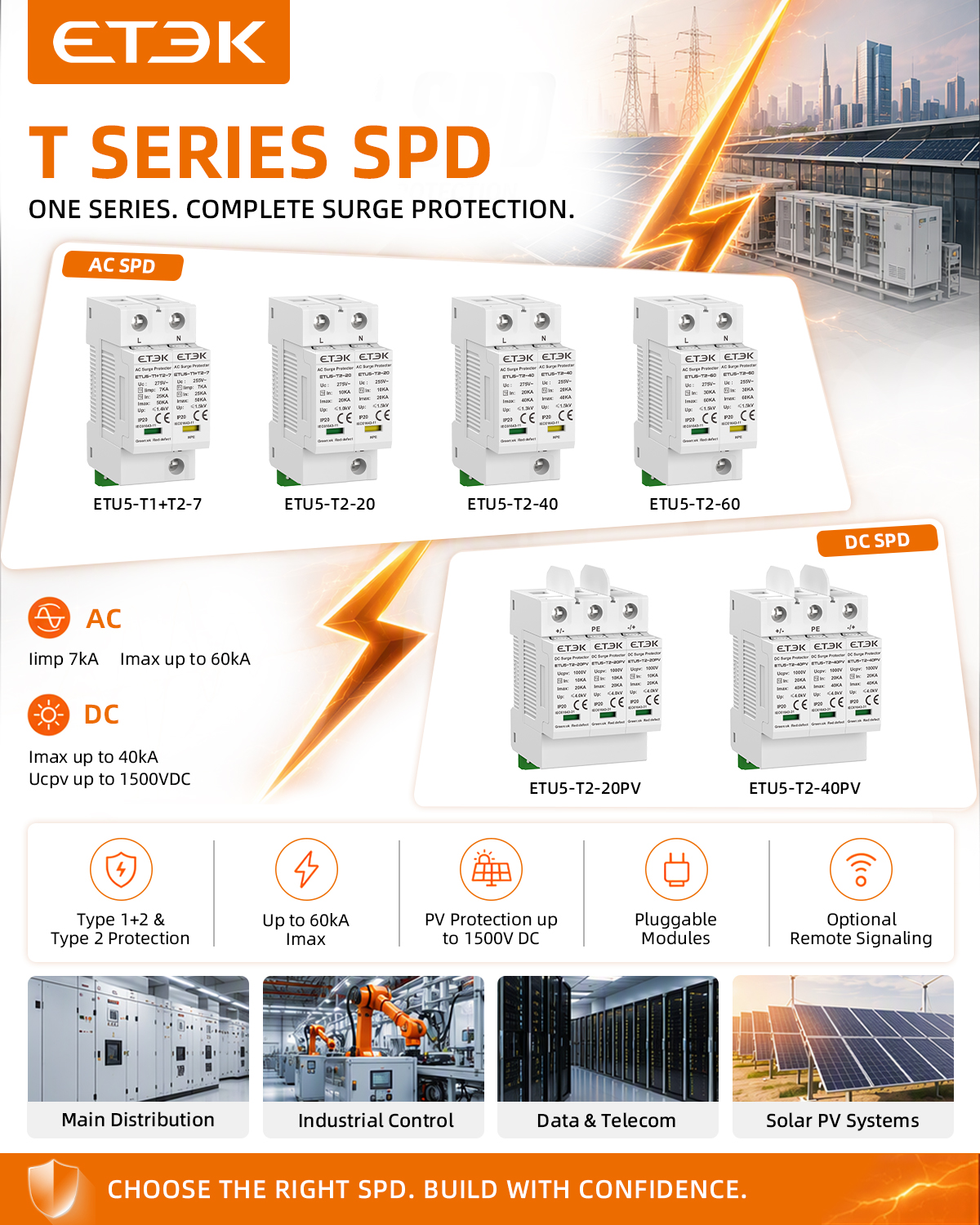
UL 1449 certifies that a surge protective device won’t catch fire or shock someone under specified test conditions, but it says little about how well the device actually protects sensitive electronics over time. A unit can sail through the standard’s basic safety checks and still allow damaging let-through voltages, respond slower than the equipment it’s meant to guard, or degrade after only a handful of moderate surges.
What tends to matter more in the field is the combination of clamping voltage under realistic surge currents, the ability to handle repeated hits without losing protection, and how tightly the device integrates with the building’s grounding and bonding. A low initial clamping figure means little if the path to ground has high impedance or if shared neutral connections let surge energy bypass the protector entirely.
Also worth checking are the manufacturer’s published let-through voltage graphs, the surge current rating per mode, and whether the unit includes thermal disconnects or end-of-life indicators. These details separate a device that simply passed a baseline safety test from one that will still be doing its job years later after dozens of real-world spikes.
The Hidden Failure Mode: Thermal Runaway in MOV-Based Protectors
Metal oxide varistors (MOVs) are widely trusted for clamping transient voltage spikes, yet their degradation path often goes unnoticed until it's too late. Under repeated surges or sustained overvoltage conditions, the zinc oxide grains inside an MOV gradually lose their non-linear resistive properties. This aging process increases leakage current, which in turn generates heat. Because MOVs are typically encased in epoxy or polymer housings with poor thermal conductivity, the heat cannot dissipate efficiently. A feedback loop emerges: higher temperature lowers the MOV's clamping voltage, allowing more current to flow, which raises the temperature further. This self-reinforcing cycle is the essence of thermal runaway.
The danger of thermal runaway lies in its deceptive onset. Unlike a catastrophic short circuit that trips a breaker instantly, thermal runaway can smolder for hours or even days. The MOV remains functional enough to pass routine tests, but internally its ceramic disc is cracking, its coating is charring, and the risk of open flame or explosive rupture is mounting. In many field failures, the first visible sign is a scorched circuit board or melted wiring near the protector, long after the initial electrical stress has passed. This delayed manifestation complicates root-cause analysis and leads engineers to overlook MOV degradation as a primary failure mechanism.
Preventing thermal runaway requires a multi-layered approach. Thermal disconnects, typically a spring-loaded solder joint that melts at a predetermined temperature, can physically disconnect the MOV from the line before it reaches critical heat levels. Pairing MOVs with series-connected gas discharge tubes reduces standby leakage current, while monitoring circuits can flag abnormal increases in quiescent current. Designers should also select MOVs with higher energy ratings and derate them for ambient temperature extremes. Field data from insurance investigators and reliability labs consistently shows that unprotected or under-protected MOV banks are a leading cause of electrical fires in surge-protected equipment, making thermal management not just a performance issue but a fundamental safety requirement.
Why Bulk Buyers Should Care About Real-World Clamping, Not Just Nominal Ratings
Nominal clamping ratings look impressive on a spec sheet, but they rarely tell the whole story. In a real shop, the material you're gripping, the condition of the jaws, and even the air pressure on a given day can knock those numbers down fast. A vise that holds 10,000 pounds in a lab might slip at half that when it's clamped onto a rough casting or a thin-walled tube. Bulk buyers who chase the biggest static number often end up with workholding that underperforms on the floor, leading to scrapped parts and frustrated operators.
The gap between rated and actual clamping force shows up most clearly in high-mix or heavy-cut environments. For example, a hydraulic vise rated at 8 kN may only deliver 5 kN once the pump has been running for an hour and the fluid warms up. Meanwhile, a mechanical vise with a lower nominal rating but a more consistent force curve might hold better throughout the day. That kind of real-world behavior matters more than a single peak number when you're buying fifty vises for a production line—every unit needs to perform the same way, not just shine in a controlled test.
Savvy bulk buyers test clamping force on actual workpieces, not just on clean steel blocks. They ask how force decays after repeated cycles, how the mechanism behaves with coolant contamination, and whether the clamping point drifts under vibration. These details show up in scrap rates and cycle times, not in marketing brochures. Paying attention to real-world clamping means fewer surprises, less downtime, and a better return on a large tooling investment.
From Main Breaker to Sensitive Loads: Where Each SPD Type Earns Its Keep
At the main breaker, a Type 1 SPD handles the brute force of a direct lightning strike or utility switching surge before it can spread through the building. This is the first line of defense, and it has to be tough enough to live on the line side of the service disconnect without any upstream protection. From there, the energy that does get through—now clipped but still potent—needs a Type 2 SPD at the distribution panel. This unit catches the leftovers and knocks them down to a level that branch circuits can tolerate. Without this stage, sensitive electronics on those circuits would repeatedly see spikes that shorten their lifespans.
But even a well-coordinated Type 1 and Type 2 combination leaves a residual voltage that can upset microprocessor-based equipment. That's where Type 3 SPDs come in, installed close to the sensitive loads themselves—think workstations, medical devices, lab instruments, or audiovisual racks. By placing protection only a few feet from the load, you minimize the let-through voltage that reaches the equipment. The key isn't just picking one type; it's staging them so each SPD does the heavy lifting where it's designed to operate, and they work together without fighting each other.
Wholesale Partnerships That Keep Your Trucks Rolling During Storm Season
When a severe storm slams into your service area, every idle truck cuts into revenue and delays critical deliveries. Wholesale partnerships built around storm-season demand give you more than a price break — they put you first in line for hard-to-source parts like wiper motors, alternators, and suspension components. Instead of scrambling across multiple vendors, you have a supplier that understands regional weather patterns and pre-stocks the items your fleet is most likely to need.
The real advantage shows up in the details: negotiated bulk pricing on high-wear parts, flexible reorder points that adjust as forecasts shift, and dedicated account contacts who can reroute shipments when roads close. Some partners also hold reserve inventory for their most active buyers, so a sudden freeze or flood doesn't leave your maintenance bays waiting on backorders.
That kind of dependability changes how your shop runs. Mechanics spend less time on the phone chasing stock and more time turning trucks around. And because pricing is locked before peak demand hits, you can plan labor and budget without the usual storm-season markup surprise. It's not just a supply chain — it's a buffer against the worst weeks of the year.
FAQ
It clamps transient overvoltages—like those from lightning strikes or switching operations—before they reach sensitive equipment, diverting excess energy to ground and keeping voltage within safe limits.
Because power quality directly affects customer retention. Bulk buyers want devices that reduce downtime and equipment failures, so offering units with low let-through voltage and high surge current ratings becomes a competitive edge rather than a commodity add-on.
Start with the service entrance: check the nominal system voltage, maximum continuous operating voltage (MCOV), and available fault current. Then match the surge current rating to the exposure level—higher kA ratings for areas with frequent storms or critical loads. Don't forget coordination with downstream panels.
Type 1 units install on the line side of the main breaker and handle direct lightning hits. Type 2 units go on the load side of service panels and protect against switching transients and residual surges. Most wholesale programs stock both because they serve different points in the distribution.
Yes, but you need to verify the device's voltage rating matches the inverter or generator output, especially in floating or grounded systems. Many modern SPDs handle DC and AC sides, so wholesale buyers often pair them with solar arrays or backup generators to protect power electronics.
Long lead lengths are the biggest killer—every extra inch of wire adds impedance and reduces clamping performance. Also, using undersized conductors or ignoring the manufacturer's torque specs. A clean, short connection to the busbar with dedicated grounding makes more difference than buying the highest kA rating.
It depends on surge activity. Units with visual indicator windows or remote dry contacts let you spot end-of-life without opening panels. In high-exposure sites, check quarterly; in moderate environments, an annual inspection usually catches degraded metal oxide varistors before they fail silently.
Look for UL 1449 4th edition listing, plus IEC 61643-11 for international markets. That ensures tested voltage protection ratings and safety. Some buyers also ask for ANSI/UL 96A compliance for lightning protection systems, especially in industrial or telecom projects.
Conclusion
A reliable surge protection strategy starts with reading the electrical distribution you already have, then selecting SPDs that fit that reality. Too many projects force a one-size-fits-all protector into panels with different fault currents, grounding schemes, and load profiles. UL 1449 certification is useful as a baseline, but it does not tell you how a device behaves under repeated transients or elevated ambient temperatures. The most serious risk in MOV-based protectors is thermal runaway: once a varistor begins to degrade, it can draw more current, heat up, and eventually fail violently if no coordinated thermal disconnect is present. That is why real-world clamping performance deserves more attention than nominal ratings alone.
Bulk buyers who manage multiple facilities or distribution yards should look past the headline surge current number and evaluate let-through voltage under realistic surge waveforms. A protector at the main breaker does different work than one at a sensitive control panel, so matching the SPD class to the location prevents both under-protection and wasted spend. During storm season, the difference between a prolonged outage and a quick recovery often comes down to having the right units on hand and a wholesale partner who can ship them without delay. Stocking a range of surge protective devices that match your distribution, rather than waiting for a failure, keeps operations running when grid instability hits.
Contact Us
Contact Person: Andy
Email: [email protected]
Tel/WhatsApp: +86 13356133008
Website: https://www.etek-china.com/